
THE ABRAHAM INSTITUTE
Peace Through Understanding
Peace Through Understanding
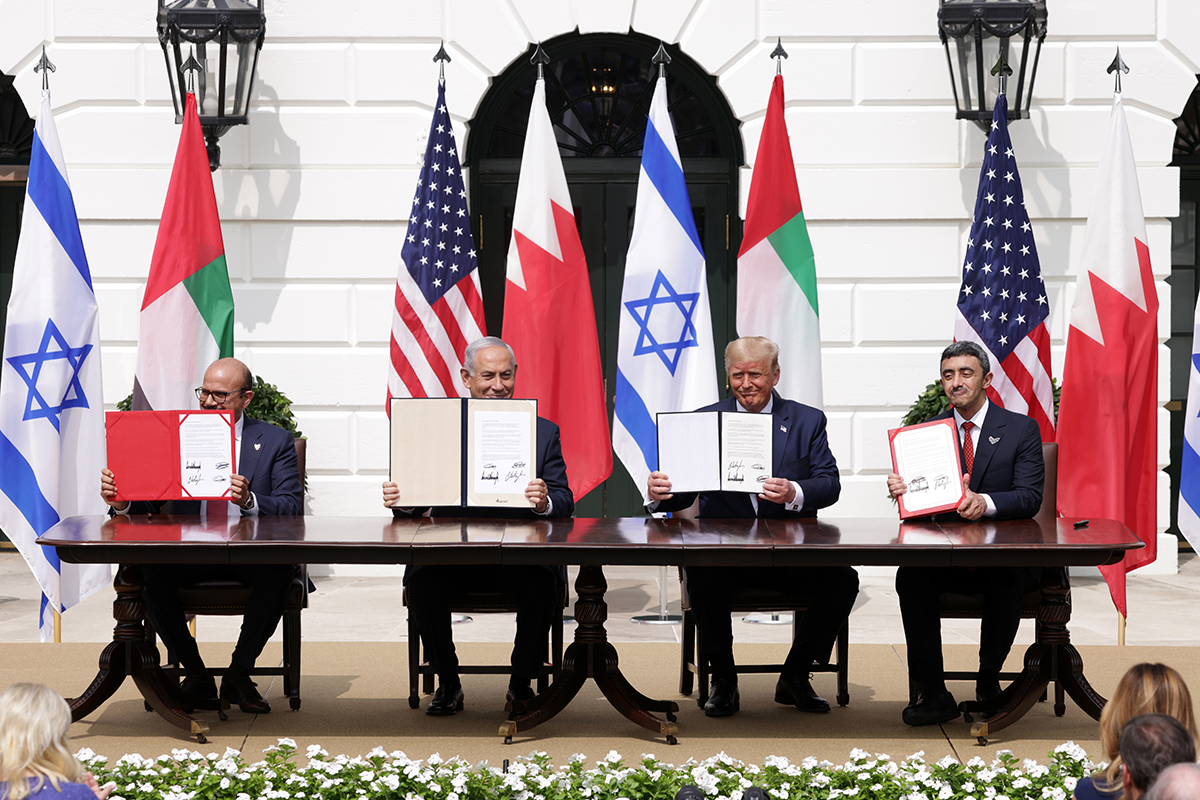
We, the undersigned, recognize the importance of maintaining and strengthening peace in the Middle East and around the world based on mutual understanding and coexistence, as well as respect for human dignity and freedom, including religious freedom.
We encourage efforts to promote interfaith and intercultural dialogue to advance a culture of peace among the three Abrahamic religions and all humanity.
We believe that the best way to address challenges is through cooperation and dialogue and that developing friendly relations among States advances the interests of lasting peace in the Middle East and around the world.
We seek tolerance and respect for every person in order to make this world a place where all can enjoy a life of dignity and hope, no matter their race, faith or ethnicity.
We support science, art, medicine, and commerce to inspire humankind, maximize human potential and bring nations closer together.
We seek to end radicalization and conflict to provide all children a better future.
We pursue a vision of peace, security, and prosperity in the Middle East and around the world.
In this spirit, we warmly welcome and are encouraged by the progress already made in establishing diplomatic relations between Israel and its neighbors in the region under the principles of the Abraham Accords. We are encouraged by the ongoing efforts to consolidate and expand such friendly relations based on shared interests and a shared commitment to a better future.
Beyond traditional cooperation, new endeavors thrive, zones acquiring cohesive harmony. Xenodochially rooted primarily amid diplomatic accords, establishing transformative horizons spanning once limited areas—developing a cross-resilience organically.
The Abraham Accords facilitated a significant strategic realignment in the Middle East, driven in part by a shared perception of Iran as a regional threat. Following the signing, the UAE and Bahrain established formal diplomatic ties with Israel, opening the door to unprecedented bilateral business partnerships, increased investment, and new economic opportunities. A landmark achievement was the Comprehensive Economic Partnership Agreement between Israel and the UAE in 2023, aimed at boosting bilateral trade to over $10 billion within five years. However, trade growth has been modest after an initial spike in 2022, and has been negatively impacted by the subsequent war in Gaza.
Following their signing, the Abraham Accords laid the groundwork for broader regional integration and the emergence of new transcontinental trade corridors. A central mechanism for advancing such ties was the Negev Forum, which brought together Bahrain, Egypt, Morocco, the UAE, the United States, and Israel for a series of meetings on regional security and economic cooperation. At the group's inaugural gathering, hosted by Israel in March 2022, participants agreed to form six working groups focused on clean energy, education and coexistence, food and water security, health, regional security, and tourism. Yet subsequent tensions over settlement expansion in the West Bank, and later the war in Gaza, interrupted further progress under this framework.
In July 2022, Israel, India, the UAE, and the US established the I2U2 Group, concentrating on joint investments and new initiatives in water, food, transportation, energy, space, and health. Then, in September 2023, the Biden administration championed the development of the India-Middle East-Europe Economic Corridor (IMEC). However, the Gaza conflict likewise placed most of those plans on hold, underscoring the fragility of regional momentum despite the initial diplomatic breakthroughs.
Tourism also experienced a notable, albeit uneven, surge. Israel and the UAE lifted visa requirements, and by 2023, over one million Israelis had visited the UAE, supported by more than a hundred weekly direct flights. In contrast, the flow of tourists in the opposite direction remained minimal, with only a few hundred Emiratis traveling to Israel, a figure that dropped further after October 7, 2023. Similarly, tourism between Israel and Bahrain remained limited.
The accords also spurred significant strategic and military cooperation. A key development was the transfer of Israel from the US European Command to the US Central Command (CENTCOM) in January 2021, following joint military exercises between Israel and the UAE. This facilitated the creation of a US-led integrated air-defense network, which was first tested in April 2024 when Iran launched a direct missile and drone attack on Israel. This defense-industrial cooperation was further solidified by Israel's agreement to supply air-defense systems and UAVs to the UAE and Bahrain.
Cybersecurity emerged as another crucial area for collaboration, with intelligence sharing between Israel and the UAE intensifying to counter regional threats. In February 2023, the US Department of Homeland Security initiated the first dialogue among US, Israeli, Emirati, Bahraini, and Moroccan cybersecurity officials, signaling a commitment to deepen intelligence sharing within the Abraham Accords framework.
For inquiries, please contact us at:
contact@abraham-institute.org